Ontology of Emergence
The Ontology of Emergence is an open structural model describing how awareness and consciousness can arise from progressively organized layers of differentiation, stability, and recursive perception. The model emerged from recognizing several incongruities in the common scientific statement that “consciousness emerges from complexity.” While complexity clearly plays an important role, the phrase itself often leaves critical foundational questions unresolved: What is complexity acting upon? Why do stable structures form at all? Why does perception arise from increasing complexity rather than remaining a simple mechanical interaction? And how does awareness emerge without circularly assuming the existence of an observer or experience beforehand?
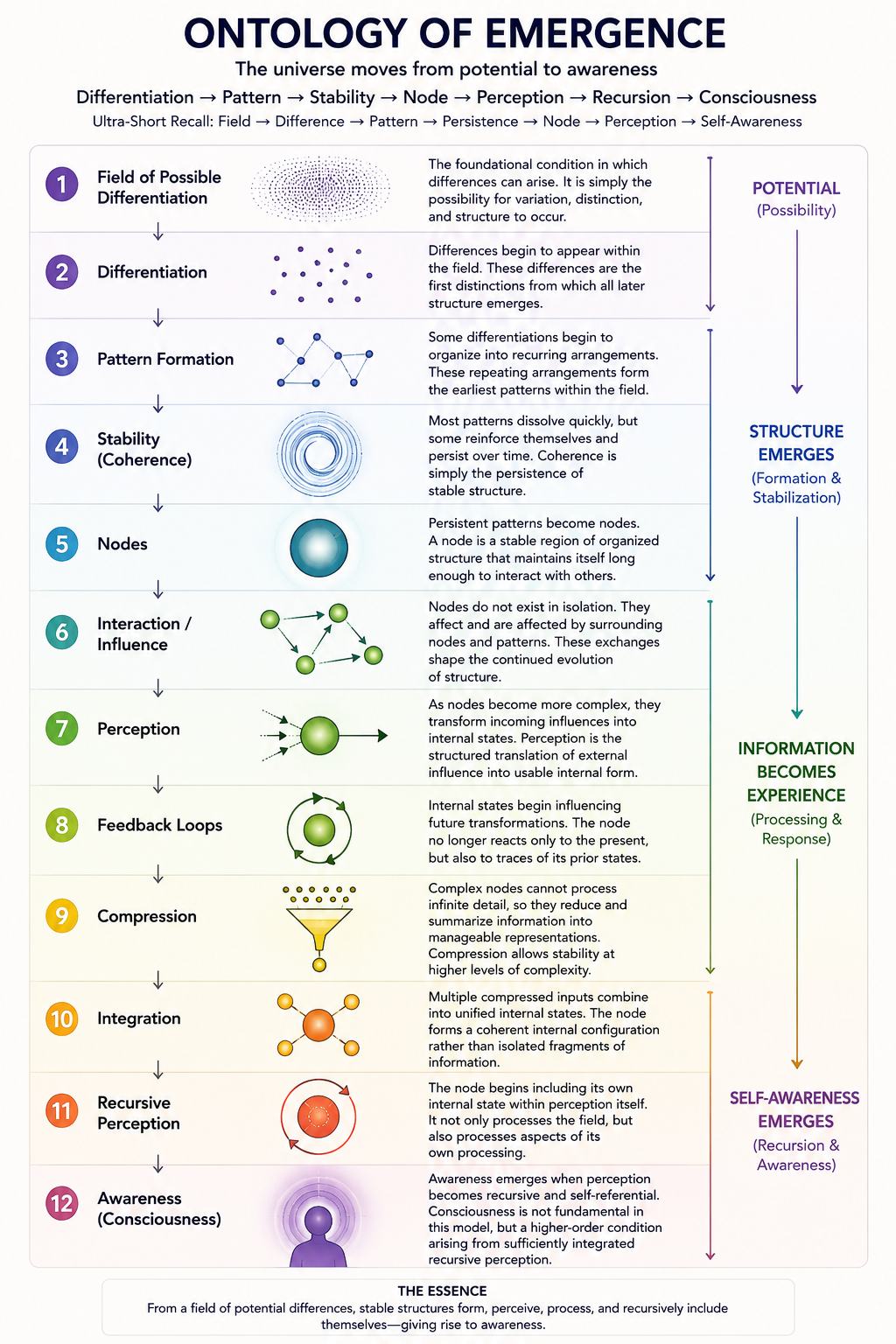
Rather than assuming consciousness, experience, or a predefined subject as fundamental, this model begins with a field of possible differentiation and builds upward through increasingly stable and complex structures. The importance of this stack is that each layer emerges naturally from the conditions established by the layer below it, creating a continuous and non-circular explanation for how perception, awareness, and ultimately self-awareness can arise within the universe without requiring mysticism, hidden assumptions, or a predefined observer.
- Field of Possible Differentiation
- Differentiation
- Pattern Formation
- Stability (Coherence)
- Nodes
- Interaction / Influence
- Perception
- Feedback Loops
- Compression
- Integration
- Recursive Perception
- Awareness (Consciousness)
Field of Possible Differentiation
The foundational condition in which differences can arise. It is not made of objects, observers, or experiences. It is simply the possibility for variation, distinction, and structure to occur.
Differentiation
Differences begin to appear within the field. These differences are the first distinctions from which all later structure emerges.
Pattern Formation
Some differentiations begin to organize into recurring arrangements. These repeating arrangements form the earliest patterns within the field.
Stability (Coherence)
Most patterns dissolve quickly, but some reinforce themselves and persist over time. Coherence is simply the persistence of stable structure.
Nodes
Persistent patterns become nodes. A node is a stable region of organized structure that maintains itself long enough to interact with other structures.
Interaction / Influence
Nodes do not exist in isolation. They affect and are affected by surrounding nodes and patterns. These exchanges shape the continued evolution of structure.
Perception
As nodes become more complex, they transform incoming influences into internal states. Perception is the structured translation of external influence into usable internal form.
Feedback Loops
Internal states begin influencing future transformations. The node no longer reacts only to the present, but also to traces of its prior states.
Compression
Complex nodes cannot process infinite detail, so they reduce and summarize information into manageable representations. Compression allows stability at higher levels of complexity.
Integration
Multiple compressed inputs combine into unified internal states. The node forms a coherent internal configuration rather than isolated fragments of information.
Recursive Perception
The node begins including its own internal state within perception itself. It not only processes the field, but also processes aspects of its own processing.
Awareness (Consciousness)
Awareness emerges when perception becomes recursive and self-referential. Consciousness is not fundamental in this model, but a higher-order condition arising from sufficiently integrated recursive perception.